

Automation reshapes the floor plan of modern facilities, but the transition requires a calculated approach. Deploying automation without clear criteria often leads to bottlenecks rather than breakthroughs. Success hinges on a precise evaluation of daily tasks to determine which steps benefit from automation and which require human adaptability.
Operations typically feature a mix of high-value cognitive tasks and routine, cyclical actions. Isolating these routine actions provides a roadmap for technological investment. When evaluated correctly, standardizing the right workflows directly leads to measurable gains in output and consistency.
The Matrix of Repetition
The most reliable indicators for automation candidacy are predictability and volume. Tasks that follow an unchanging sequence of events-where inputs are uniform and outcomes are identical every time-form the foundation of robotic integration. If an operator handles the exact same component at the same angle every ninety seconds, that process is prime for technological transition.
High volume amplifies the return on investment. A process executed thousands of times a week scales efficiently under automated systems, whereas irregular tasks rarely justify the initial programming and setup costs.
Error rates in manual handling also signal a need for structural change. Human fatigue naturally introduces variance during repetitive shifts, leading to micro-defects or sorting mistakes. Automated systems maintain identical precision on the first hour of operation as they do on the twenty-fourth.
Mapping Workflows for Mechanical Consistency
Identifying these opportunities requires systematic observation rather than guesswork. Process engineers often begin with time-and-motion studies, breaking a shift down into discrete individual actions.
When analyzing a workflow, look for three specific operational characteristics:
- Low cognitive variance: The task requires minimal subjective decision-making or real-time troubleshooting.
- Physical symmetry: The parts, bins, and machinery remain in fixed spatial coordinates throughout the shift.
- Predictable cycle times: The duration of the task does not fluctuate based on external variables.
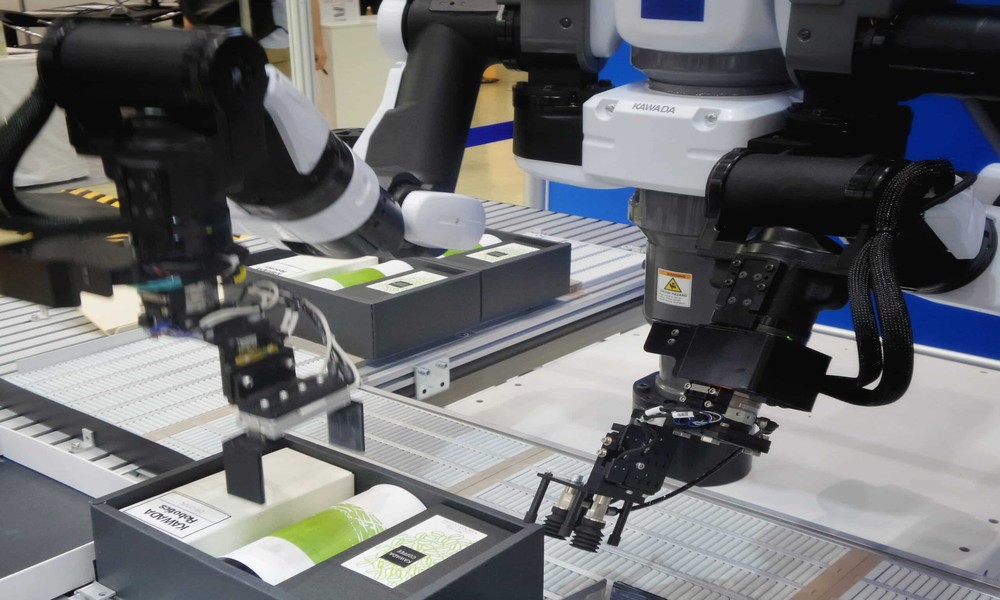
Consider a standard packaging line where products arrive on a conveyor, get placed into a corrugated box, and receive a shipping label. The physical parameters are constant. The system knows exactly where the box is, how heavy the product is, and where the label must land. This predictability removes the need for complex, real-time adjustments, making it a classic candidate for machinery to take over.
Balancing Traditional and Flexible Systems
Once a process is flagged for automation, the next step involves choosing the right technological framework. Traditional industrial robotics excel at high-speed, high-volume isolation. They operate behind safety fencing, moving heavy payloads with extreme velocity.
However, many modern facilities feature dynamic layouts where humans and machinery must share the workspace. In these environments, flexible automation fills the gap. Exploring various collaborative robot applications allows facilities to automate precise tasks like machine tending, sanding, or palletizing alongside existing personnel without erecting massive safety barriers. These systems adapt quickly to changing production runs, making them highly effective for operations characterized by low-volume, high-mix product portfolios.
Material handling presents another clear target. Moving pallets across a warehouse floor or transferring components between assembly stations consumes valuable time without adding direct value to the product. Replacing manual transport with automated guided vehicles or flexible robotic arms frees skilled workers to focus on quality assurance and complex assembly.
Evaluating Technical Feasibility
Not every repetitive task is easy to automate. Physical limitations can quickly complicate a project, driving up integration costs.
Component variability poses a major hurdle. If parts arrive warped, tangled in a bin, or with highly irregular surfaces, standard mechanical grippers struggle to adapt. While advanced vision systems can resolve these challenges, they add layers of programming complexity and cost.
Tooling changes must also be factored into the equation. A process that requires swapping out mechanical components multiple times a day requires versatile end-effectors or automated tool changers. If the setup time for the machine exceeds the time saved during operation, the process should likely remain manual for the time being.
Environmental conditions dictate equipment choices as well. Extreme temperatures, airborne particulates, or moisture require specialized robotic enclosures and maintenance schedules. The physical environment must match the durability rating of the planned hardware to prevent premature failure.
Calculating Operational Readiness
Successful deployment extends beyond the technical specifications of the machinery. The surrounding infrastructure must support continuous operation. This means upstream processes must supply materials at a speed that matches the automated cell, and downstream processes must be capable of absorbing the increased output without creating a new bottleneck.
The internal team needs the capability to manage the new system. While modern programming interfaces have become significantly more intuitive, the workforce still requires training to handle basic troubleshooting, recipe changes, and preventative maintenance.
Refining the layout of the facility often becomes necessary during this transition. Designing tight feedback loops and optimized physical cells ensures that the introduction of automated machinery streamilnes the entire production floor rather than creating isolated islands of efficiency. Continuous data collection from these integrated systems provides the insights needed to tune performance over time, turning initial floor adjustments into long-term operational advantages.