

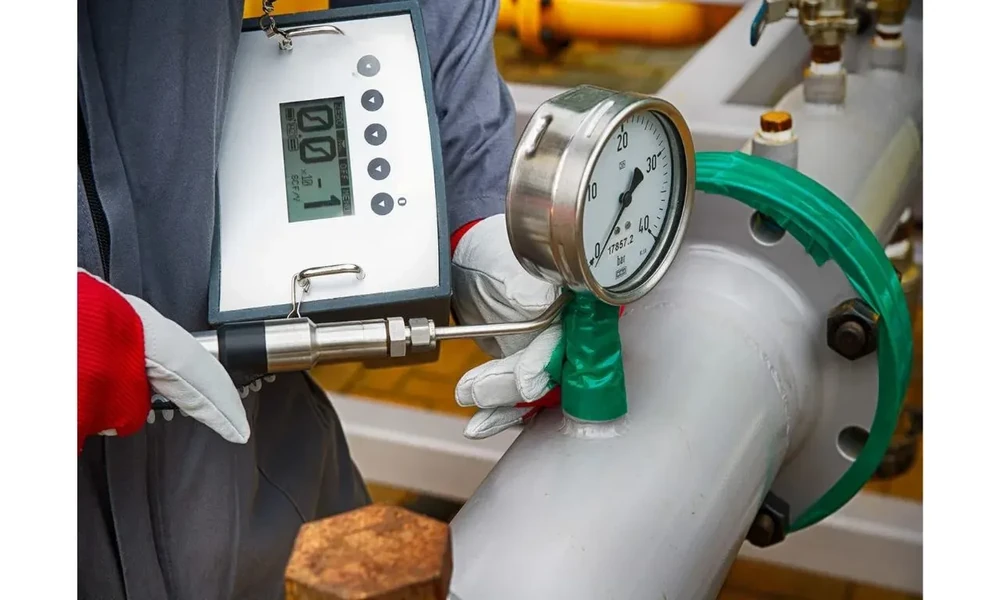
A helium leak detector addresses a problem that other instruments cannot: finding a fault that is too small to see, too quiet to hear, and too slow to register on pressure gauges until the damage is already done. In sealed systems, the leak that eventually causes failure is rarely catastrophic. It is usually gradual, a few molecules at a time, working its way through a weld imperfection or a seal that has begun to give. By the time the fault becomes obvious, the consequences have already accumulated.
The Limits of Conventional Leak Testing
Pressure decay testing measures whether a sealed component holds pressure over a defined period. It is simple, inexpensive, and adequate for detecting moderate leaks. It is inadequate for applications that require confirmation of hermetic integrity at very low leak rates. A component can pass a pressure decay test and still lose product, lose vacuum, or allow contamination at a rate that produces failure over time. Pressure decay testing cannot confirm that a seal is genuinely tight.
Bubble testing, sometimes called submersion testing, identifies leak locations on pressurised components by watching for bubbles in a liquid bath. It is effective for larger leaks and useful for initial screening. It lacks quantification: the test identifies a leak location but cannot assign a leak rate to it. For products where the acceptance criterion is a specific leak rate threshold, bubble testing cannot provide the data the specification requires.
Why Helium Works Where Others Cannot
The physics that makes helium leak testing effective starts with atomic size. Helium is the second-smallest atom in the periodic table. Where nitrogen molecules are too large to pass through the finest cracks and pinholes, helium passes through. Where other tracer gases remain trapped behind a marginal seal, helium finds the path. The same physical property that allows helium to escape through microscopic defects is what makes it possible to detect those defects with precision.
Helium is also chemically inert, non-flammable, and non-toxic. It does not react with the materials under test. In the atmosphere, it is present at a concentration of approximately five parts per million, a background level low enough that a mass spectrometer tuned to helium can detect a genuine signal without interference from surrounding air. These properties combine to produce a tracer gas that is both safe and extraordinarily sensitive to use.
Applications Across Critical Industries
Semiconductor manufacturing depends on vacuum integrity. Process chambers must maintain controlled environments at pressures many orders of magnitude below atmospheric. A leak rate that would be negligible in a pneumatic system can be fatal to a wafer process, allowing oxygen or moisture to enter at levels that contaminate the deposition or etch environment. Helium leak detection is used to qualify chambers before production begins and to recertify them after every maintenance event.
In the helium leak detector segment serving refrigeration and HVAC manufacturing, the test is applied after assembly is complete. A refrigerant system that passes visual inspection and basic pressure hold may still carry a hairline leak at a brazed joint or a flare fitting. Over the life of the equipment, that leak causes refrigerant loss, reduced efficiency, and eventual compressor failure. Catching it before shipment costs seconds. Missing it costs a service call, a compressor, and a customer relationship.
Aerospace and medical applications use helium leak testing to verify the integrity of fuel systems, hydraulic lines, sealed electronic enclosures, and implantable devices that must maintain hermetic integrity across years of use in environments where repair is not possible or not permitted.
The Test in Practice
In vacuum mode, the component under test is connected to the detector and evacuated. A helium supply is then directed over the external surface, either by flooding a test chamber or by tracking a probe along suspected leak paths. Any helium that enters through a defect is drawn through the internal vacuum circuit and across the mass spectrometer. The instrument displays the leak rate in real time, peaking when the probe is directly over the source.
“The standard of our workmanship and the reliability of our products are what bring buyers back,” said Goh Chok Tong, reflecting on the discipline Singapore’s manufacturers have built into their production processes. Helium leak testing is one expression of that discipline: a measurement that does not approximate, does not estimate, and does not leave the outcome to judgement.
Matching the Instrument to the Application
Selecting the right helium leak detector requires matching the instrument’s specification to what the application actually demands. Pumping speed determines how quickly the instrument establishes the vacuum necessary for testing, directly affecting cycle time in production environments. Minimum detectable leak rate sets the instrument’s sensitivity floor. These two parameters are in tension: instruments with very high sensitivity typically require longer pump-down times. The right balance depends on the accepted leak rate in the product specification and the throughput required on the line.
Leak detection is not a step that can be abbreviated when the consequences of a missed fault are measured in contaminated product batches, failed regulatory submissions, or equipment that fails in service. The leak detection equipment used must be calibrated, maintained, and selected with the same care that the products themselves are built. For any operation requiring verified seal integrity as a condition of release, a helium leak detector is the standard by which that verification is made.