

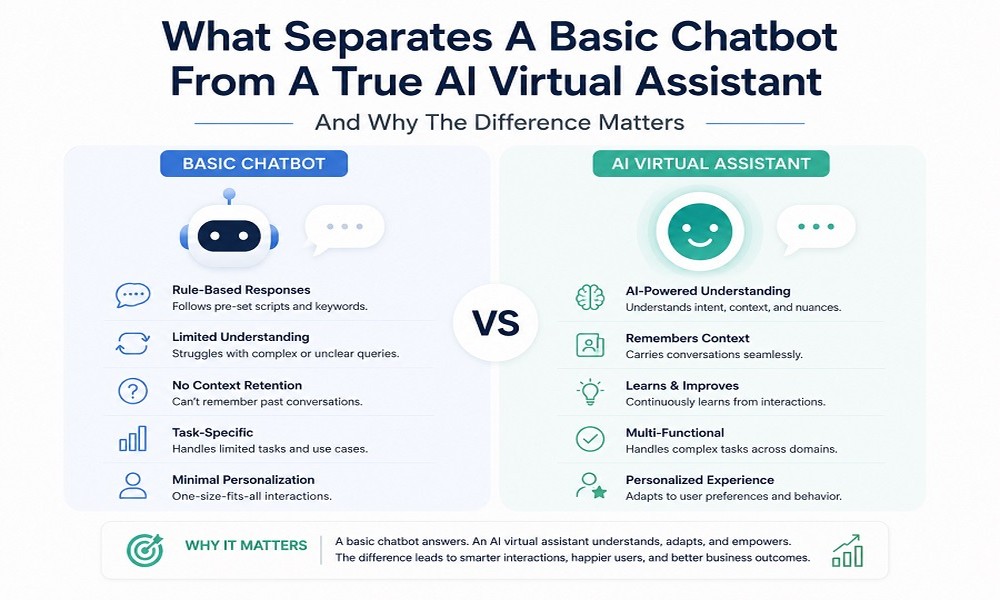
Ask most business owners what a chatbot does and they will give you a reasonable answer. It answers questions. It handles basic queries. It saves the support team some time.
Ask them what an AI virtual assistant does and the answers get vague. Many assume it is the same thing – just a fancier label for the same tool.
It is not. And the gap between the two has very real consequences for businesses that pick the wrong one.
A basic chatbot operates on a relatively simple premise. Someone asks a question, the system matches it to a pre-written response, and the answer goes back. Sometimes this matching is keyword-based. Sometimes it uses a decision tree – if the customer says X, show option A, B, or C.
This works for a narrow set of use cases. Store timings. Basic FAQs. Routing customers to the right department.
The ceiling hits fast, though. The moment a customer asks something that does not match a trained pattern – or phrases a familiar question in an unfamiliar way – the system either gives a wrong answer or admits it cannot help. Both outcomes push the customer toward a human agent, which defeats the efficiency argument for automation in the first place.
The deeper problem is that chatbots do not learn from these failures. Every unmatched query is a dead end, not a data point.
Where an AI Virtual Assistant Works Differently
An AI virtual assistant is built on a different architecture entirely.
It does not match inputs to fixed responses. It interprets what the customer is actually asking – intent, context, the specific entities involved – and generates or selects a response accordingly. It holds conversation state, so a reference to “that order I mentioned” three messages ago does not confuse it.
More importantly, it handles variation. The same underlying request phrased ten different ways – including with spelling errors, mixed languages, or incomplete sentences – gets recognised as the same request. For businesses operating across India’s linguistically diverse customer base, this is not a minor feature. It is a fundamental operational requirement.
An AI virtual assistant also knows what it does not know. When a query falls outside its confidence threshold, it escalates – with context intact – rather than looping or guessing. That handoff quality is something basic chatbots almost never get right.
The Business Impact of Getting This Wrong
The cost of choosing a basic chatbot when the use case demands an AI virtual assistant does not show up immediately. It shows up in the metrics over time.
Escalation rates stay high. Customer satisfaction scores plateau. The support team that was supposed to be freed up ends up handling the same volume of complex queries – just after a frustrating automated interaction that made the customer more irritated than before.
There is also a data cost. A chatbot interaction that ends in failure teaches you nothing useful. An AI virtual assistant generates structured data about intent patterns, resolution rates, and conversation drop-off points. That data feeds back into the system and into broader business decisions.
Businesses that have been running the wrong tool for two or three years are not just behind on technology – they have also missed two or three years of learning.
How to Tell Which One You Are Actually Looking At
The demo will not tell you. Both tools look functional when the inputs are clean and the questions are predictable.
Push on the edges. Ask what happens when someone writes in Hindi. Ask what the escalation path looks like. Ask how the system handles a query it has never seen before. Ask whether it can pull live data from a backend or only answer from a static knowledge base.
The answers separate a scripted bot from a genuine AI virtual assistant quickly.
Final Thought
The label does not matter as much as the capability. A lot of tools marketed as AI virtual assistants are still operating closer to the chatbot model underneath. And a lot of businesses are paying for sophistication they are not actually getting.
The difference matters because customer experience compounds. Every interaction either builds confidence or erodes it. A tool that cannot handle real conversations will make that erosion happen faster than doing nothing at all.
