

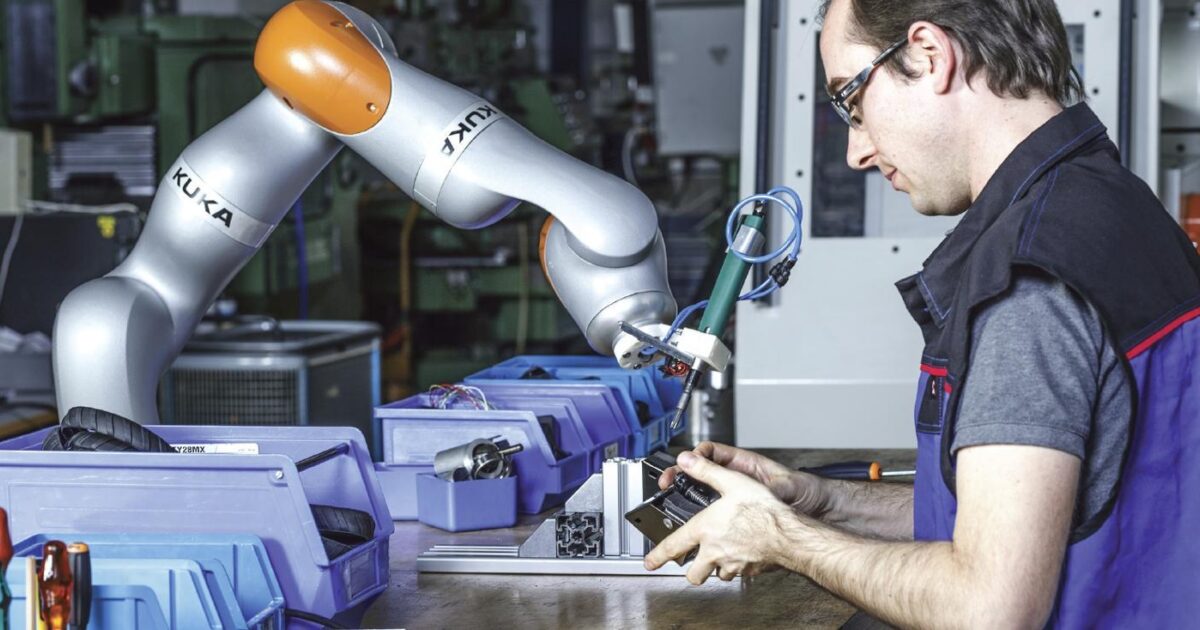
Collaborative robots, or cobots, have changed the way production floors operate by removing the physical barriers between human workers and machines. Unlike traditional industrial robots that follow rigid, pre-programmed paths regardless of their surroundings, cobots rely on sensory feedback to interact with the world. Among these inputs, the measurement of force stands out as the most critical factor for both operational safety and process quality.
The Role of Force in Contact Processes
Most manufacturing tasks involve physical contact. Whether it is sanding a wooden surface, assembling electronics, or polishing metal, the robot must apply a specific amount of pressure to achieve the desired result. Without force feedback, a robot is essentially “blind” to the resistance it encounters. It might press too hard, damaging the workpiece, or too lightly, leading to a finished product that fails quality standards.
Integrating force measurement transforms a robot from a simple motion machine into a tool capable of tactile sensation. This allows the system to maintain a constant pressure even if the geometry of the part varies slightly. In finishing applications, this stability is the difference between a uniform surface and one riddled with inconsistencies.
Security and Human-Robot Interaction
Safety is the primary reason force sensing was developed for collaborative environments. International safety standards define specific limits for the force and pressure a robot can exert if it happens to come into contact with a human. Modern cobots often have internal current monitoring to detect collisions, but these systems sometimes lack the sensitivity required for high-speed or delicate operations.
External sensors provide a much higher degree of resolution. By monitoring force in real-time, the control system can trigger an immediate stop or a “backdrive” motion if it detects an unexpected resistance. This capability ensures that any collision remains well below the thresholds that would cause injury, making the workspace truly shared.
Enhancing Quality with Torque and Force Data
Beyond safety, the data gathered from the robot’s wrist allows for sophisticated process control. In precision assembly, for example, a robot might need to insert a pin into a hole with a clearance measured in microns. If the parts are slightly misaligned, a standard robot would simply crash. A sensor-equipped robot, however, can detect the “side force” and adjust its position dynamically to find the correct path.
To achieve this level of sophistication, many integrators utilize a 6 axis force torque sensor mounted at the robot’s flange. This hardware measures forces and torques along all three axes, providing the controller with a full spatial understanding of the interaction. Using this information, the system can implement adaptive control strategies where the robot’s path is not fixed, but rather dictated by the physical feedback of the task.
Technical Constraints and Calibration
Implementing force control is not without its challenges. Engineers must account for signal noise and measurement latency. Every sensor requires a certain amount of filtering to produce usable data, but excessive filtering can introduce delays that slow down the robot’s reaction time. Finding the balance between a clean signal and a fast response is a central task for automation engineers.
Calibration is another essential factor. Gravity acts on the robot’s tool (end-effector), and as the robot moves, the weight of that tool shifts relative to the sensor’s axes. Modern software handles “gravity compensation” by calculating the tool’s mass and center of gravity, effectively “zeroing” the sensor so that it only measures the external forces applied by the process itself.
Impact on Tooling and Component Longevity
Consistency in force application does more than just improve the surface finish; it extends the life of the equipment. When a robot applies excessive force during a grinding or deburring process, it accelerates the wear on abrasive materials and puts unnecessary stress on the robot’s joints. By optimizing the pressure, maintenance managers can predict tool changes more accurately and reduce the total cost of ownership for the robotic cell.
This move toward force-aware automation represents a shift from “blind” repetition to “intelligent” adaptation. As sensors become more integrated with robot controllers, the barrier to entry for complex contact tasks continues to drop, allowing smaller enterprises to automate processes that once required a skilled human hand.
Future developments in this field are likely to focus on even higher sampling rates and the integration of artificial intelligence to interpret force patterns. This will allow systems to not only react to force but to predict potential process failures or tool wear before they impact the production line.
